2012-09-22

Dovetails by Hand


This blog is supposed to be about “woodworking on a less than infinite budget,” but so far I've been neglecting what I think is the real heart of frugal woodworking: using hand tools. In fact, I would guess that the most lavish thousand-dollar shop possible would be an all hand tool shop equipped with used (and some vintage) gear. 


I was thinking about this last Saturday as I taught my hand-cut dovetails class at Highland Woodworking. You don't need much gear to cut dovetails, and the difference between mediocre and Krenov-quality dovetails has far more to do with technique and practice than equipment. What do you need to cut dovetails? Some marking tools, a saw, a hammer and a couple of chisels. Throw in a way to hold the work still and a place with decent light to work in, and you're all set. Even if you think you'll do most of your woodworking with power tools, you need all those anyway, with the possible exception of the dovetail saw.


Sharp saw, sharp chisels, sharp eye, and practice: these are what it takes. How do you practice? Mark a knife line, split it with the saw, and remove the waste. That's all of woodworking in a nutshell, isn't it? Mark a knife line, split the knife line, remove the waste.

2012-08-26

Lights! Camera!


For several years I had two borrowed photographic light stands in my shop. I used them for taking photos, holding up backdrops, and sometimes as task lighting for things like sanding or finishing where a raking light at just the right angle is necessary for the best results. Then last month I had to return the borrowed stands, and realized I didn't want to shell out the money for this. Which is just for the stand, mind you, not this too.

So, until I can afford to splurge on that kind of gear, I decided to jury rig something out of stuff I had on hand. My “jury rigs” have a way of lasting for years, so whatever I made needed to be fairly durable and it had to work well. With a bit of head scratching and a couple of false starts, I came up with this, which I'm pretty pleased with:


Keep reading to see about the process of building it. If you don't want to click through and read, here's one key nugget of information buried back in there: the screw on a standard tripod head, and the corresponding threaded hole on the bottom of your camera, is just plain old 1/4-20. (At least, here in the U.S. I can't speak for Europe or Asia)

2012-06-24

Sharpening with Sandpaper


I have said elsewhere that sharpening on sandpaper is the cheapest way to start sharpening, and the most expensive way to continue. That's because you can scrounge up what you need to make a razor-sharp edge on a chisel or plane iron for well under $20. But then the sandpaper wears out pretty quickly, and it retails for around a dollar a sheet. Even if you find it for 50 cents a sheet in bulk, compare that to a $30 water stone that lasts for a couple of decades, and you'll see what I'm saying.

So why bother? Like I said, it's the cheapest way to get going, and you can spend just a little bit to get sharp tools for your first few projects, and then invest in more permanent equipment later on. The cheap honing guide I recommend for beginners will work on water stones or diamond plates as well. And even though I own a set of great water stones, I still use sandpaper when I'm out on an installation and don't want the mess, or the risk of theft or breakage, that go along with using water stones outside my own shop. And wet or dry sandpaper is good for flattening water stones. So when you get additional sharpening gear later on, you don't have to fret about wasting money on sandpaper sharpening.


2012-06-17

Sharpening: Extra Coarse


I learned this trick from Mark Duginske a couple of years ago: drywall mesh is great for flattening plane soles. It's also great for flattening water stones. So I wondered to myself: would it also be good as the very coarsest sandpaper in the “Scary Sharp” method? Turns out the answer is “kinda, sorta.”

I'll backtrack a little in case any of this is new to you. Here's a picture of drywall mesh:

You can find it in the big box home stores in the same area as the drywall tools, tape, and joint compound. It is coarse, and the mesh structure lets sanding dust (or iron filings) fall through so the mesh can keep cutting. In drywalling, it's used after you've taped and mudded, to quickly get the surface ready for paint. As you can see from the photo, it's die cut into a tabbed shape to fit a special holder with a handle.

2012-05-13

35mm hinge boring jig . . . without a drill press

The easiest way to bore holes for 35mm hinges (a/k/a cup hinges, concealed hinges, or Euro hinges) is with a drill press, and one of my other posts shows a great drill press jig for making sure all your hinges are in consistent locations. A drill press is great to have, and I think it's one of the first machines you should get, BUT it might not be something you buy with the first $1,000 you spend on woodworking equipment. Most of us will want a tablesaw or bandsaw, a router, and perhaps a planer first. 

The 35mm hinge is the standard for kitchen cabinets because it's affordable, it's durable (if you buy a good brand), and most of all, it's adjustable, so that when you put the door in place and it's not quite parallel with its opening, or a bit higher than it's supposed to be, you can adjust it with the turn of a couple of screws, while the door remains in place.

The hinge fits into a hole of 35mm (1-3/8") diameter about 12mm (1/2") deep, bored in the stile of the door. The hole is best bored with a "forstner" bit, or other bit that leaves a flat-bottomed hole, since you don't want the pilot of a spade bit or auger bit to poke through the face side of the door. And forstner bits are notoriously tricky to use with a handheld drill, especially in larger diameters, because of their extremely short pilots - - the very feature that makes them good for this job. So what to do, short of going out and buying a drill press?

Give this jig, or one like it, a try. It's simply a good, thick slab of flat material with a 35mm hole bored in it.* Actually, the hole in this one is 1-3/8", but that's close enough for Euro hinges, just a hair loose but it works fine.

If you're going to use it with a handheld drill, the jig needs to be at least as thick as the body of your forstner bit, plus the pilot, so probably around 3/4" thick. If you're going to use it with your router and a pattern cutting bit, the thickness needs to be enough to let the bit spin freely while the bearing is low enough to follow the edge of the hole. So if the cutting length of the bit you're using is 1", you should use a jig around 1-1/4" thick. The one in the photos is 1-1/2" thick, which is a bit too thick for the bit I used, as you'll see.


Position the hole so that it's around an inch in from the long edge of the jig. That will leave room for a fence, which will determine the distance between the edge of your door stile and the hinge hole. This distance is critical for determining how much your door overlays its opening. In the next photo you can see the fence, which is made of nice straight wood that's thinner than any door I'll ever bore with this jig:


The fence is positioned to put the edge of the hinge hole about 3mm in from the edge of the door stile. This distance works great for the hinge I use most often, Blum's Clip-Top 120.

Using the jig is simple: clamp it down where you want your hole, carefully put the drill bit into the hole, spin it up to full speed before it hits wood, and drill until you're deep enough. The sides of the hole in the jig keep the bit square enough to the stile for your purposes.


(Safety notes: you see those safety glasses on the bench? Those are extras. I was wearing mine but you can't see them in the picture. For real! Safety glasses aren't optional when you're drilling a big hole. Also, you nitpickers have already noticed I need to replace the power cord on this drill. This is a 5-minute job and will be the subject of a subsequent post, because most power tools need a new cord every few years.)

Here's the resulting hole:


You can also use this jig with a plunge router and a pattern following (bearing above cutter) bit:


Notice that the jig is thick enough for the bit to spin freely (not cutting wood) while the bearing is low enough to be guided by the jig. This is important. On the other hand, with this bit I think a thickness of 1-1/4" instead of 1-1/2" would work better.


And here you see why: notice how the columns are bottomed out? I could barely plunge a hole deep enough for the hinge without starting to rub the bottom of the collet on the jig.


Using this jig with the plunge router is easy. Clamp jig to workpiece at a comfortable height, plunge bit to within 1/8" of workpiece surface, turn on motor, and rout around and around the hole while gradually plunging to the full depth of your hole. Most pattern bits aren't designed to plunge straight down to full depth, so you have to keep moving the router and let the side of the bit do the cutting instead of the end.


Routed hole on the left, drilled hole on the right. The routed one is slightly cleaner and doesn't have the dimple in the middle from the drill pilot - - but all this is covered up once the hinge is installed. The router takes about the same amount of time as the drill, but throws the dust around more violently (and grinds it finer). 


*I hear the objection: how can I make this jig if I don't have a drill press? I have several suggestions.
1) make friends with someone who has a drill press, and show up at their house with your prepared jig stock, the 35mm bit you'll use to bore your doors, and an appropriate gift.
2) buy this jig from me. Oops, sorry, my son asked if he could have it. I'm not sure why. 
3) pay me to make a new jig. Oh, did I just say that? I guess I could. I'm kind of busy, though.
4) make your jig out of mdf, like I did. It cuts like cheese. Try your hand at using the forstner bit freehand. Your first try won't go well. Your second try might go better. Once you finally get a sort of clean hole (typically, they have messy beginnings and neat endings, the opposite of love affairs), use your best hole as a jig for making a better hole. Use that hole as the jig for making this jig.
5) buy a 1-3/8" spade bit, a good one with spurs on the edges, and use that to make the jig.
6) buy a 1-3/8" hole saw, and use that to make the jig. (Note: I don't know if this will work. Just an idea. The resulting hole might be way too big!)

2012-04-22

Drawer Pulls


As I draw near to completing this little storage cabinet for my shop, I'm taking care of details. This weekend I realized that I'm about ready to install the drawer faces, but didn't have pulls yet.

I've used a version of these pulls on other furniture built for myself, and find them quite practical. They're easy to grip, they're friendly to the hands, they don't stick out enough to hurt you as you walk by. And they're free! I won't go into lots of details here, just show you some photos of making them.

They're made from white oak that's 5/8” thick and 2-1/2” wide. I think if I were doing these over again, I'd go for 1/2” thick stock, but I had a bunch of 5/8” left over from making drawers and it was on top of the pile.
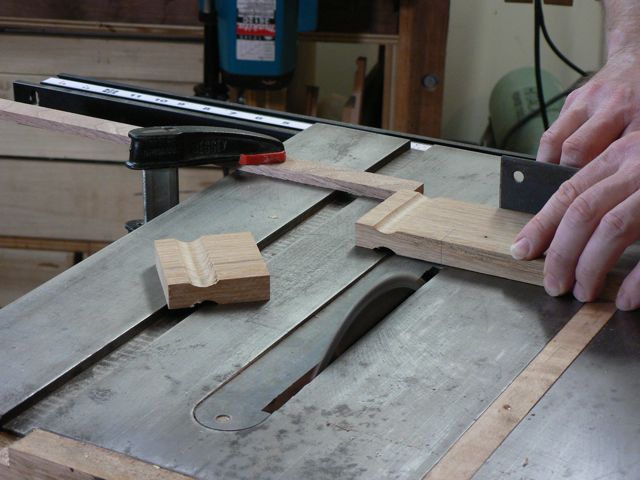
Hard to tell in this photo, but I'm using a following block to make it easier to hold the pull blank square to the fence.


Rounding over with a 1/16 radius makes them friendly to the hand and resistant to splintering. I shouldn't have done the rear of the pull, where it will be inside the mortise in the drawer front, because now there's a tiny gap to amuse the nitpickers.

Hopefully when I install, I'll keep the end grain lined up consistently from piece to piece.

The mortise in the drawer face is cut almost completely by hand, then finished with the router and a pattern bit.

At the end, you see them mocked up on the walnut drawer faces they'll be glued and/or screwed to when installed for good. I'm not sure about the white oak/walnut contrast, though I don't think it will look bad when the finish goes on. My approach in making these shop cabinets has been to use whatever material I have on hand as often as possible. This year, that has meant white oak, walnut, and wormy maple, with birch countertops. Next year it will probably mean thick, bluestained pine.


2012-04-02

Mounting Euro Hinges: a no-dollar drill press jig


Cup hinges, 35mm hinges, Euro hinges, concealed hinges, whatever you call them they sure make door installation easier. Compared to anything else, getting all the doors to line up parallel with each other is far easier with a cup hinge!

Here's a quick tip on how to bore the holes consistently, door to door, so that when you go to install you can slap on the baseplate, drive the screws, and pop on the door.

You'll notice I use a drill press. Perhaps a drill press wasn't in your $1,000 budget? I think it should be something you consider having when you start out, and if you find that woodworking is for you and you'll do it forever, definitely get a drill press. Even a benchtop model, if it's half decent, will be useful to you in many, many ways.

If you don't have a drill press, you could just as easily make yourself a similar jig for spacing the hinges in from the end of the door, and bore the hole with a handheld drill (or better yet, the router with a pattern bit!).

The first thing to determine is the distance from the edge of the door to the edge of your hole. Varying this will vary the amount of overlay your doors have when you're done. Please, as always, at least glance at the spec sheet for your hinges, and then test out the idea on scraps before you commit to hole placement on those doors you've lavished with so much hard work!

On this drill press table, the flip-stops on the fence are meant to be the same distance from the center of the bit, so that the holes at the ends of the doors are symmetrically placed. If you have more than 2 hinges per door, vertical placement of the other holes is not critical and doesn't need to be consistent, as long as you don't put a hinge right where a shelf has to be. During installation, just install the two end hinges, then clip the baseplate to the other hinges, close the hinges, and screw the baseplates to the face frame wherever they fall. Automatic fit.

I'm going to let the pictures do the talking for the rest of this entry.