Showing posts with label router. Show all posts

2016-08-25

IWF 2016


Today I attended IWFS 2016 just a few stops down MARTA from where I lay my head at night. Here are a few photos and a few thoughts.


Approaching the Georgia World Congress Center from the closest MARTA station. I had to chuckle at the obvious out-of-towners who piled onto my train car at Five Points, quite wary of their reputedly dangerous surroundings. When I attended my first IWFS in 1998, I was the same way. I thought my adopted town did a good job of welcoming the visitors today. 


I don't think there's any one spot where you can see the entire expanse of either Building A or Building B. This was the closest I got to an overlook. In this shot you're seeing about 5% of one of the two halls. If you walked all through the whole venue without stopping, it would take several hours. And it's packed. And it's loud - - after all, machinery is being demonstrated all over the place!


I was struck by the fact that some of the vendors who made their names selling traditional machinery like bandsaws, tablesaws, jointer/planers, etc. now have booths totally dominated by CNC equipment. That was the case with Laguna, which had a couple of dust collectors and bandsaws off on the periphery, and Felder, which had a few more non-CNC machines (including the awesome 16" Format 4 jointer/planer), but still were both clearly there to sell CNC.


Kreg was there to unveil new products that we can't have yet! They have revamped their slide installation jigs, and I can tell you they'll be in use in my cabinet classes as soon as I can get a pair.


Kreg also had a very promising-looking jig for doing Euro hinge holes with a handheld drill. When I was told the price I asked "That doesn't include the drill bit, does it?" It does. And the drill bit is carbide. Again, I will have one of these for my classes to try out ASAP.


This makes sense too, why didn't they think of it before? Starting in November, you'll be able to make your own Kreg pocket hole plugs in scraps from your own lumber, so your holes can be concealed with matching wood. They wouldn't let us try it ourselves, but the samples they had on display were fantastic.


What would a woodworking show be without a bit of carnival huckster action? It slices! It dices! It makes julienne fries!


Of course the Stiles guys were doing their own huckster routines too, just hawking higher-priced goods. It's not a product, it's a relationship!


Why so serious? It's only a sander.


Keep the damn robots behind glass.


I heartily recommend you take a look at this video, which I find fascinating and horrifying. https://www.youtube.com/watch?v=sAmyZP-qbTE Yes, I know it's a parody.


Edgebanding.


Many of the new pieces of equipment have touchscreen rather than levers or wheels. Equipment operators are flying by wire these days.


A gigantic dust collection system that dominated several rows of booths.


Another sander.


Rikon was there with what looked like a new jointer-planer, no doubt sourced from the same factory as the Jet and Grizzly versions; I happen to like this color scheme better. They also had a 24" bandsaw which I hadn't seen before. Perhaps they've had it a while already and Highland doesn't carry it?


Plenty of software suppliers were on hand.


Lee Valley/Veritas were there with the same display they have had at every show I've seen them at, ever.


 One nice change since I had last seen this booth is that they give you a chance to feel all their knob and tote offerings side by side. The differences are quite subtle, but real. Walking away, I thought of how many other hands had grabbed those knobs, and it gave me the willies. Maybe Veritas should offer hand sanitizer.


Makita's cordless sliding compound saw. Am I the last person to learn about this? Makes sense to me, but I am committed to a different brand of cordless tools for family reasons.


Today was also the first time I saw the Bosch "REAXX" system in the wild. Carry it home for slightly less than the equivalent SawStop.


I couldn't get close enough to actually see the demonstration. People seemed impressed though!


The student furniture is always among my favorite things to visit.


This chair seemed to be the most proficiently executed of all the pieces. Great design, flawless workmanship. Not very groundbreaking, not very flashy, but it was my choice for "best in show" because the design will fit with almost any decor and the workmanship is inspiring.


Why would you go to the car show without kicking the tires on the Ferrari? If I won the lottery I would have a shop full of Martin equipment. My student Mike and I talked to one of the salesmen about the big shaper. A good guy, with lots of experience running Martin shapers and lots to say about them.

I have been to IWFS in boom years and bust years. This year wasn't really either, but the place was packed with people who seemed like they were there to either spend money or make serious decisions about mid-term spending.

Not shown in photos: Lignomat had a small, low-key booth but I got to speak with a charming employee who knows more about wood and drying it than I ever will. My favorite new CNC maker is Axiom: their smallest unit has cast iron table and frame, and all three axes of movement are via ball screw, not stepper motor. I have a fascination with ball screws. You should too. Byrd Tooling is always fun to visit; everyone working in that booth seems like a down-to-earth, small-town person even though they know they're all rock stars in the woodworking world. I had big doubts about Blum's motor-driven door openers and slides, but they are just plain seductive in person. And Knape-Vogt: I always thought of them as second tier. Their booth today changed my opinion.

I'm very glad I went, even though I left with aching feet and knee. The day was inspirational and I got to meet a couple of old friends. This industry is full of good people working very hard to get good ideas out to us makers. 

2016-06-12

Test Driving Chris Black's Router Plane


Yesterday's mail included a package from Chris Black in North Carolina. Late last week I realized I have been thinking about getting a router plane for a long time, but never pull the trigger. Looking forward a few months, I have some projects in mind that involve lots of dadoes in pine or poplar, so I called Chris. In addition to the tools he makes for sale, like an awesome birdcage awl and the best sanding block (seriously, when my partner saw it she tried to steal it!) Chris usually has a small pile of really nice old Stanley and other equivalent tools that he's restored for sale. I called him up and asked what he has on hand.

Turns out everyone and his siblings have been asking for router planes lately, so Chris has decided to make his own wooden version. He offered to let me have a look at his “Mark II” prototype. I sent some money by PayPal, he shipped it, I received it. I like it!

2015-03-09

New-Old Class

I have been teaching classes at Highland Woodworking long enough that there's at least one class which another great teacher developed, and then I taught several times after he left, and which I then quit teaching, and now we're bringing it back. But it's been so long since we've run this class, that I don't remember a thing about it!

I've forgotten how to teach this class SO COMPLETELY that I am basically starting from scratch. I have forgotten the size, except for a single dimension: 5 inches, which is the width of the apron. How wide was the top? How narrow was the taper of the legs? What was the total height? Heck if I know! I've made a few guesses and drawn a police-artist type "reconstruction" with SketchUp. 


(Artist's reconstruction)


What I do know is this: it's a very handsome Shaker-style end table. Jason Howard, now at Hardwoods Incorporated, designed both the table and the class, which was very popular in the early 2000's. The mortise/tenon connection between legs and aprons was done back then via Beadlock, which I'm not sure exists any more. The class always built it in cherry, which was very much in vogue in the 90's and 00's.

This is a great beginning project if you'd like to try your hand at solid-wood furniture. It is small and simple enough to build in 3 (admittedly intense) nights, and take home in your car. If you're new to woodworking, you'll learn some important basic skills like gluing up a wide panel, a fundamental wood joint (mortise & tenon), organizing work flow, and switching between machines for brute basic shaping and hand tools for finishing touches (both shaping and surfacing).

We're doing it next week. Join us if you can, as we rediscover one of Highland's great classes! We'll be building it in cherry (old school!) but I'm not yet decided on the joinery method. Not by hand, not by Beadlock. I guess that leaves Leigh FMT, Festool Domino, or floating tenons via my home-made mortising jig.

2013-11-10

1-2-3 Blocks


Here's a quick post in praise of 1-2-3 blocks. They come in pairs, they're quite affordable, and I think you should at least know about them. Most woodworkers haven't heard of them, most woodworkers don't have them. They come from the machine shop, but why should those guys have all the cool precision stuff to themselves? Other items that woodworkers have lifted from the machine shop include the combination square, the engineer's square, the dial indicator (for setting up table saws and planers), the dial caliper (for measuring thickness) and the precision straightedge (used both to check machine tables and the straightness of wood workpieces). This is another machine shop item we should be thinking about borrowing.


2013-01-08

Jointing with the Router


Happy New Year! I hope 2013 is kind to all of us. The last project I took on at home in 2012 was gluing up a birch countertop for my shop cabinets. In the last post, I showed how I got the big planks ready to run through the planer. In this post, which will be shorter and easier to understand, I'll show you how to get a good, straight edge on a workpiece if you don't own a jointer, or I should say, a big enough jointer.

2012-11-29

Power Cord Replacement


In an earlier post, I pointed out that I needed to replace the power cord on my drill, which is a Milwaukee 3/8” “Hole Shooter” about 10 years old. I don't know if there's something special about the air here in Atlanta, but the outer insulation on power cables seems to degrade faster here than anywhere else I've lived. When you see that the outer layer of a power cord is cracking, it's time to replace it. No ifs, ands, or buts. Don't wait until the drill (router, sander, whatever) stops working - - - by that time it may start shorting out and tripping breakers, or in a really bad case, give you a nasty shock.

This is good advice for all woodworkers, but especially for those of us trying to equip a shop on a shoestring. If you hunt for tools at estate sales or pawn shops, you may come up with some real gems at bargain prices - - if you can settle for an “as is” deal. The power cord is definitely something to inspect before you fire up a used power tool for the first time. In fact, if you're the type who likes to negotiate the purchase price, pointing out frayed insulation and saying you'll have to replace the power cord might help you find out how low the seller's willing to go.

Whether it's a vintage jewel/old beater you've just purchased, or a tool you've had for years, when you look down and see this,


then it's time to install a new power cord.

2012-05-13

35mm hinge boring jig . . . without a drill press

The easiest way to bore holes for 35mm hinges (a/k/a cup hinges, concealed hinges, or Euro hinges) is with a drill press, and one of my other posts shows a great drill press jig for making sure all your hinges are in consistent locations. A drill press is great to have, and I think it's one of the first machines you should get, BUT it might not be something you buy with the first $1,000 you spend on woodworking equipment. Most of us will want a tablesaw or bandsaw, a router, and perhaps a planer first. 

The 35mm hinge is the standard for kitchen cabinets because it's affordable, it's durable (if you buy a good brand), and most of all, it's adjustable, so that when you put the door in place and it's not quite parallel with its opening, or a bit higher than it's supposed to be, you can adjust it with the turn of a couple of screws, while the door remains in place.

The hinge fits into a hole of 35mm (1-3/8") diameter about 12mm (1/2") deep, bored in the stile of the door. The hole is best bored with a "forstner" bit, or other bit that leaves a flat-bottomed hole, since you don't want the pilot of a spade bit or auger bit to poke through the face side of the door. And forstner bits are notoriously tricky to use with a handheld drill, especially in larger diameters, because of their extremely short pilots - - the very feature that makes them good for this job. So what to do, short of going out and buying a drill press?

Give this jig, or one like it, a try. It's simply a good, thick slab of flat material with a 35mm hole bored in it.* Actually, the hole in this one is 1-3/8", but that's close enough for Euro hinges, just a hair loose but it works fine.

If you're going to use it with a handheld drill, the jig needs to be at least as thick as the body of your forstner bit, plus the pilot, so probably around 3/4" thick. If you're going to use it with your router and a pattern cutting bit, the thickness needs to be enough to let the bit spin freely while the bearing is low enough to follow the edge of the hole. So if the cutting length of the bit you're using is 1", you should use a jig around 1-1/4" thick. The one in the photos is 1-1/2" thick, which is a bit too thick for the bit I used, as you'll see.


Position the hole so that it's around an inch in from the long edge of the jig. That will leave room for a fence, which will determine the distance between the edge of your door stile and the hinge hole. This distance is critical for determining how much your door overlays its opening. In the next photo you can see the fence, which is made of nice straight wood that's thinner than any door I'll ever bore with this jig:


The fence is positioned to put the edge of the hinge hole about 3mm in from the edge of the door stile. This distance works great for the hinge I use most often, Blum's Clip-Top 120.

Using the jig is simple: clamp it down where you want your hole, carefully put the drill bit into the hole, spin it up to full speed before it hits wood, and drill until you're deep enough. The sides of the hole in the jig keep the bit square enough to the stile for your purposes.


(Safety notes: you see those safety glasses on the bench? Those are extras. I was wearing mine but you can't see them in the picture. For real! Safety glasses aren't optional when you're drilling a big hole. Also, you nitpickers have already noticed I need to replace the power cord on this drill. This is a 5-minute job and will be the subject of a subsequent post, because most power tools need a new cord every few years.)

Here's the resulting hole:


You can also use this jig with a plunge router and a pattern following (bearing above cutter) bit:


Notice that the jig is thick enough for the bit to spin freely (not cutting wood) while the bearing is low enough to be guided by the jig. This is important. On the other hand, with this bit I think a thickness of 1-1/4" instead of 1-1/2" would work better.


And here you see why: notice how the columns are bottomed out? I could barely plunge a hole deep enough for the hinge without starting to rub the bottom of the collet on the jig.


Using this jig with the plunge router is easy. Clamp jig to workpiece at a comfortable height, plunge bit to within 1/8" of workpiece surface, turn on motor, and rout around and around the hole while gradually plunging to the full depth of your hole. Most pattern bits aren't designed to plunge straight down to full depth, so you have to keep moving the router and let the side of the bit do the cutting instead of the end.


Routed hole on the left, drilled hole on the right. The routed one is slightly cleaner and doesn't have the dimple in the middle from the drill pilot - - but all this is covered up once the hinge is installed. The router takes about the same amount of time as the drill, but throws the dust around more violently (and grinds it finer). 


*I hear the objection: how can I make this jig if I don't have a drill press? I have several suggestions.
1) make friends with someone who has a drill press, and show up at their house with your prepared jig stock, the 35mm bit you'll use to bore your doors, and an appropriate gift.
2) buy this jig from me. Oops, sorry, my son asked if he could have it. I'm not sure why. 
3) pay me to make a new jig. Oh, did I just say that? I guess I could. I'm kind of busy, though.
4) make your jig out of mdf, like I did. It cuts like cheese. Try your hand at using the forstner bit freehand. Your first try won't go well. Your second try might go better. Once you finally get a sort of clean hole (typically, they have messy beginnings and neat endings, the opposite of love affairs), use your best hole as a jig for making a better hole. Use that hole as the jig for making this jig.
5) buy a 1-3/8" spade bit, a good one with spurs on the edges, and use that to make the jig.
6) buy a 1-3/8" hole saw, and use that to make the jig. (Note: I don't know if this will work. Just an idea. The resulting hole might be way too big!)

2012-04-22

Drawer Pulls


As I draw near to completing this little storage cabinet for my shop, I'm taking care of details. This weekend I realized that I'm about ready to install the drawer faces, but didn't have pulls yet.

I've used a version of these pulls on other furniture built for myself, and find them quite practical. They're easy to grip, they're friendly to the hands, they don't stick out enough to hurt you as you walk by. And they're free! I won't go into lots of details here, just show you some photos of making them.

They're made from white oak that's 5/8” thick and 2-1/2” wide. I think if I were doing these over again, I'd go for 1/2” thick stock, but I had a bunch of 5/8” left over from making drawers and it was on top of the pile.
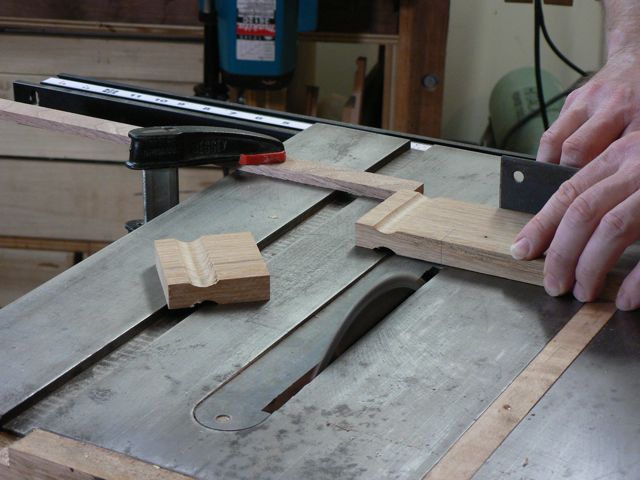
Hard to tell in this photo, but I'm using a following block to make it easier to hold the pull blank square to the fence.


Rounding over with a 1/16 radius makes them friendly to the hand and resistant to splintering. I shouldn't have done the rear of the pull, where it will be inside the mortise in the drawer front, because now there's a tiny gap to amuse the nitpickers.

Hopefully when I install, I'll keep the end grain lined up consistently from piece to piece.

The mortise in the drawer face is cut almost completely by hand, then finished with the router and a pattern bit.

At the end, you see them mocked up on the walnut drawer faces they'll be glued and/or screwed to when installed for good. I'm not sure about the white oak/walnut contrast, though I don't think it will look bad when the finish goes on. My approach in making these shop cabinets has been to use whatever material I have on hand as often as possible. This year, that has meant white oak, walnut, and wormy maple, with birch countertops. Next year it will probably mean thick, bluestained pine.