Here's
a wood finish that looks like a million bucks, and you can apply it
with minimal equipment and materials.
2013-04-07
2013-03-24
Cabinet Installation
When
woodworkers take my basic cabinet class, we don't have a chance to
install cabinets during the class, so we take some time to discuss
installation on the last night of class. Here's a short version of
what I say in class, and what Mark Duginske and I will cover in the
Installation chapter of our cabinetmaking book:
2013-03-19
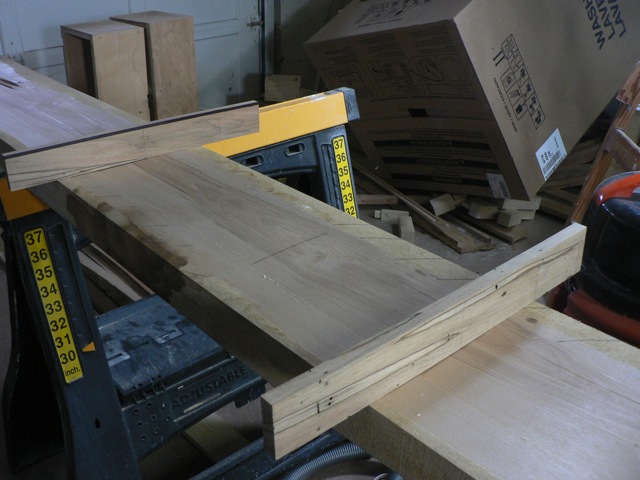
Flattening Glued-up Panels
Sorry
it's been a while since the last entry! Things have been crazy at work, but I'm still working wood and I still have plenty
more to share with you guys, so please bear with me. I've been
tracing the process of making a countertop. That has actually been done for a month or so, and I installed it on top of a run of cabinets in my shop. So today I'll backtrack a bit to cover flattening a big panel.
2013-01-17
What is the Thousand-Dollar Shop?
This
question came up recently when a friend of mine discovered my blog.
It’s a natural question, and the answer has to do with why I
started blogging here. I’ve been putting this entry off, because
it’s a lot of words with no good pictures, and every time I’ve
tried to write it, it's felt too long and too negative. But we need to
do this, so let’s go.
It
starts with another friend of mine, Kevin, and his experience when he
got serious about woodworking.
2013-01-08
Jointing with the Router
Happy
New Year! I hope 2013 is kind to all of us. The last project I took
on at home in 2012 was gluing up a birch countertop for my shop
cabinets. In the last post, I showed how I got the big planks ready
to run through the planer. In this post, which will be shorter and
easier to understand, I'll show you how to get a good, straight edge
on a workpiece if you don't own a jointer, or I should say, a big
enough jointer.
2012-12-09
Surfacing Big Boards without a Big Jointer
How do
I surface a big board if I don't have a jointer? In this post, I'm
going to show you one way to do it. There are many ways to skin this
particular cat, but this way works, and the basic principles apply in
lots of situations.
Getting
some big boards surfaced is the first step in a project that will
stretch out across several blog posts:
2012-11-29
Power Cord Replacement
In an
earlier post, I pointed out that I needed to replace the power cord
on my drill, which is a Milwaukee 3/8” “Hole Shooter” about 10
years old. I don't know if there's something special about the
air here in Atlanta, but the outer insulation on power cables
seems to degrade faster here than anywhere else I've lived. When you
see that the outer layer of a power cord is cracking, it's time to
replace it. No ifs, ands, or buts. Don't wait until the drill
(router, sander, whatever) stops working - - - by that time it may
start shorting out and tripping breakers, or in a really bad case,
give you a nasty shock.
This is
good advice for all woodworkers, but especially for those of us
trying to equip a shop on a shoestring. If you hunt for tools at
estate sales or pawn shops, you may come up with some real gems at
bargain prices - - if you can settle for an “as is” deal. The
power cord is definitely something to inspect before you fire up a
used power tool for the first time. In fact, if you're the type who
likes to negotiate the purchase price, pointing out frayed insulation
and saying you'll have to replace the power cord might help you find
out how low the seller's willing to go.
Whether
it's a vintage jewel/old beater you've just purchased, or a tool
you've had for years, when you look down and see this,
then
it's time to install a new power cord.
Subscribe to:
Posts (Atom)