Showing posts with label green woodworking. Show all posts

2020-09-27

What I Did on Summer Vacation 2020

On Friday I got home from my place near Rib Lake, Wisconsin. Since the autumnal equinox happened during the last few days of the trip, technically we can call it a late-summer visit to the woods. Temperatures were warm for September. A few nights were cool enough that I was comfortable inside my shack with a fire in the stove, but most nights were fine to sleep outside in the hammock.


Despite the warm temperatures, the sun was no longer high in the sky, as in July. Daylight hours are shorter, and the leaves turned color while I was there. Early on there were patchy bits of color here and there:


. . . but by the time I left we had sights like

2020-07-26

Roger Deakin: Wildwood


I just read Roger Deakin’s Wildwood: A Journey through Trees (Penguin, 2007). I give it my highest recommendation. Calling this book “nature writing” is like calling Bruce Chatwin's

2019-04-28

Videos Worth Watching: "Medieval Wood Riving"


A museum team in Sweden shows excellent axe techniques for felling, bucking, riving and hewing as they duplicate 40-foot-long rafters in a medieval Swedish church.

The segment on controlling the riving is my favorite. Early in the video you can see that the tree used for the original rafters has considerable twist, and the crew shows how to overcome that.

Lately I've been following the "Finnish Vintage Axes" account on Instagram, and  now I see what all those long-headed axes are for. It also looks like "mortising" axes have a more general use during the controlled riving.

The best woodworking videos give me an itch to get busy. This one does that, in spades!


2019-04-05

Stacked Birch Bark Knife Handle: New Video

I recently made and posted this video to YouTube: 

https://www.youtube.com/watch?v=Q2zDllohj-Q

it's a stacked birchbark handle! WOW!


The process of making the handle was quite enjoyable, and the result is wonderful. The handle is grippy, resilient, and warm in the hand. Even when wet! I will be making more.

2018-01-27

Seal the Ends of Green Lumber


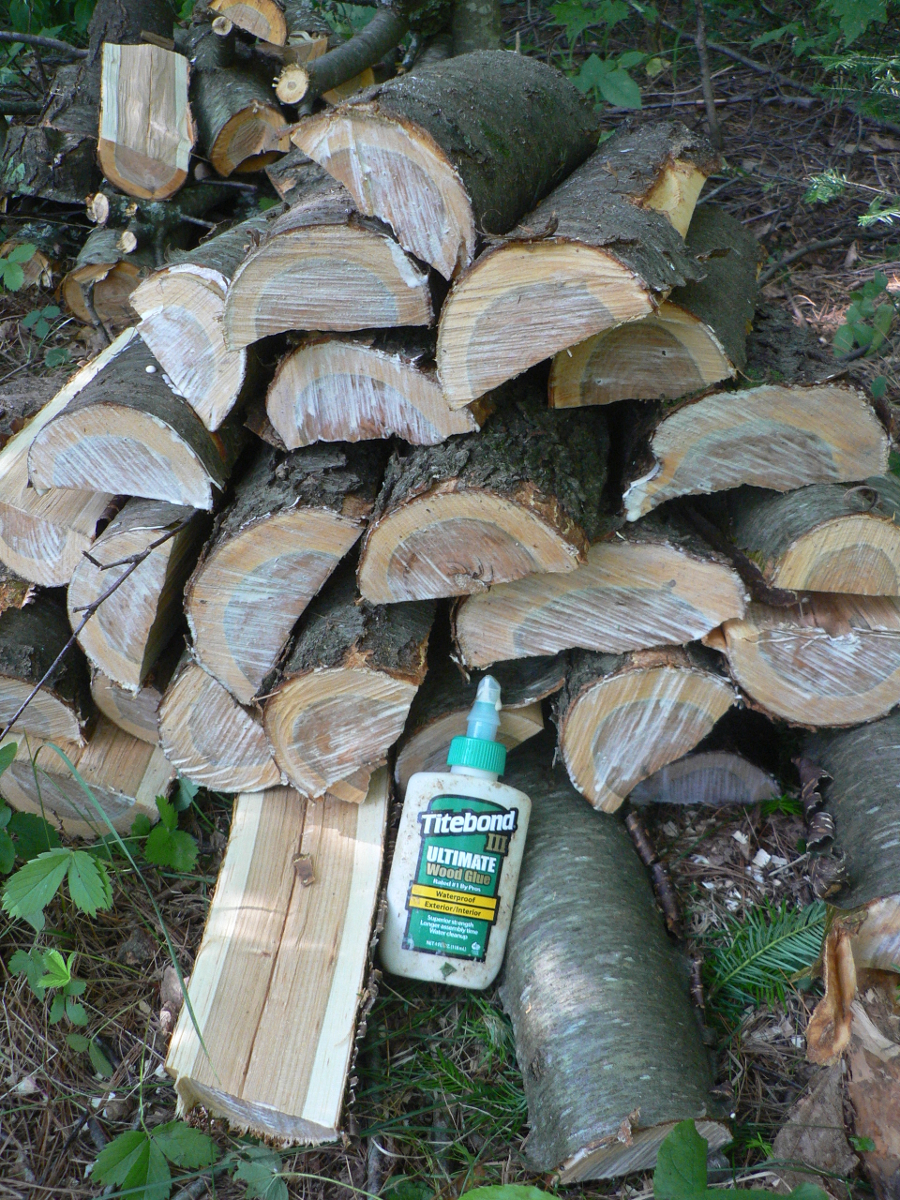
When you get lucky and score a bunch of nice fresh wood like this black cherry, seal the end grain before it starts drying out.


Moisture leaves wood most easily through the end grain, less easily through the long grain, and least easily through

2018-01-20

More Adventures in Workholding

I've been working on a change to my spoon-carving process, scooping out the bowl earlier in the process with the blank held by a clamp rather than in my hand. 


I tried it out with this tiny salt spoon, made from

2018-01-02

Video Worth Watching: Wille Sundqvist on YouTube

My teacher Drew Langsner has posted a video I love on YouTube. On several of my visits to Country Workshops, I have watched this on a VHS copy Drew has in the shop's video library. 


https://www.youtube.com/watch?v=yWeB_kFcZ34


This is basically raw, unedited footage made in 1982 by Rick Mastelli for a projected video by Taunton Press. For reasons I don't know, the project wasn't completed. I believe several black and white stills from these sessions were used in a Fine Woodworking article on the basic knife grasps.

I assume this was Wille's second trip to the U.S., when he taught the first spoon and bowl course at Country Workshops. Here you see a craftsman at the height of his powers, working in a new environment and explaining what he's doing and why in his second (third?) language. Clearly he's a master of both the work and teaching it.

Along with Wille's book, Swedish Carving Techniques, and the later Taunton video by his son Jögge, this video will give anyone interested in carving with hand tools, beginner or more advanced, plenty of food for thought. I still have new "aha" moments every time I look these over. Wonderful "ahas" I feel not just in the brain, but in the hands: one of life's great pleasures!

2017-04-09

Pruning Works!

These photos were taken yesterday as I split potential chair parts from the butt log of a northern red oak. The tree had just been felled, and had grown up in somebody's yard. It was almost exactly the same age as I (slightly north of 50), and in one of the short pieces I split, I found a branch that had been pruned off when the tree was about 25 years old. These pictures tell a story (I hope)!


The photo above shows

2016-12-27

Carving Spoons

Here are a few spoons I've completed recently. Most have some areas that are sanded, many have some areas that are knife-finished. One thing I'm learning is that even if I plan to sand the spoon, sanding time is cut way down if I do some careful finishing knife work after the spoon is thoroughly dry. (I guess I assume you know that it's easiest to do most of the carving while the wood is as wet as possible).

All of these spoons are finished with raw flax oil.

The spoons pictured are spoken for by their new owners. Others will be available in the weeks to come; watch this blog for news on that.


2016-02-15

Kiln Rebuild in the Works?


This weekend I had a chance to visit my friend Reed on his farm about an hour's drive from here. Reed has been everything from an advertising art director to a publisher to a woodworker. Before I started my present job at Fernbank Science Center, Reed and I built some cabinetry and furniture projects together, and we also built and operated a solar lumber

2015-12-13

Drying Wood in the Microwave: or, the Cursed Spoon


Three rounds of 30-second exposures in the microwave oven, with a few minutes outside in between to cool off, will dry most spoons enough to be ready for finish sanding and oiling. And that would have worked for this spoon too! But nothing about this spoon was easy. It probably shouldn't even exist. It resisted being created at almost every step of the way. And I refused to listen.

2015-02-08

Hanging on to Christmas Fun

I was afraid my spoon blanks would dry out before I got to them, which is why I was storing them in a plastic bag full of chips from the carving process. Then I was afraid that fungus would get working on the blanks before I got them finished up, so I decided to wrap them in plastic and freeze them. The idea is that if the wood is below freezing temperature, the fungus will at least slow down until I can carve the wood. Those little white packages, lower left in my freezer, are my spoon blanks:


Will this work? I don't know, it's an experiment. I think it probably will. I know that wood can dry out while frozen (water can sublimate). Hopefully, double-wrapping the blanks in plastic will keep enough water in the wood to be easy to carve, while being frozen will slow the fungus down enough so I won't be working spalted wood (unless I want to, of course).


I'll keep you posted!

2015-01-11

Spoons in January

From this:


To this:


In just a couple of hours.  Making spoons out of wood you cut down yourself is about as close to instant gratification as you find in a woodworking project.

2014-11-16

A Handplane Jig for Ladderback Chair Leg Tapering


Here's another hand tool jig. This one is more specific than the dovetail paring jig I showed in the last entry, because it's built to help with one particular step in one particular project. I use it to turn tapered square chair leg blanks into tapered octagons when I make the ladderback chair developed by J. Alexander and Drew Langsner. The dovetail jig can be used for joints of different thicknesses and widths, and I can even picture myself using it to fair up tenon shoulders. But this leg-tapering jig is so specific that I doubt it will ever be used for anything but this project.

First I'll show about making and using the jig, and then I'll explain my thinking a little bit.

2014-09-01

Make a Chopping Block for Green Woodworking


If you want to get started in woodworking on the lowest possible budget, I recommend what's called “green woodworking” or sometimes “greenwoodworking”. I've talked a little about this already, in this entry about the chairmaking class I took at Country Workshops last summer, and this entry about gathering some ash for my next chair.

One thing you will find handy if you want to start carving spoons and/or bowls from green wood is a chopping block, so you'll have a stable surface for shaping with an axe.